Below: how it works, how a cash sale compares with listing it, what to have ready, and the Hawaii tax and closing rules that change what you net. Prefer to sell it yourself? Start with our guide to selling vacant land yourself.
How selling to us works in Hawaii
- Send the address or APN, the acreage and any access or utility notes for your Hawaii parcel. No obligation.
- We check it against comparable listings and county assessments in Hawaii County (the Big Island) and Maui County and the rest of Hawaii.
- You get an offer, or a clear reason we cannot make one, and you decide.
- A title or escrow company closes the sale and the Bureau of Conveyances records the deed. No agent commission; normal closing costs apply.
Cash sale, agent listing or selling it yourself in Hawaii
- Sell to us for cash: no listing, no showings, no commission. The tradeoff is price. Expect an offer below what a patient retail buyer might pay, in return for speed and certainty.
- List with an agent: you reach retail buyers, mostly around Honolulu and Kahului, but you pay a commission and wait for a buyer. For land that can run to months.
- Sell it yourself: you keep the commission and handle pricing, photos, questions and paperwork. You can list on AcreageSale.
How to sell vacant land yourselfList it yourself with the AI lister
When a cash sale makes sense for Hawaii land
- Inherited Hawaii land you do not want to manage from a distance.
- You live outside Hawaii and cannot walk the parcel or meet buyers.
- Taxes and upkeep cost you every year it sits.
- A listing went stale, or the land is remote or has access or title questions.
What to have ready for your Hawaii parcel
- The address or APN, the acreage, and what the land is: Big Island subdivision lots in Puna, Hawaiian Acres and Hawaiian Ocean View Estates and agricultural-district lots and small farms, or something else.
- Road access: paved, dirt or an easement.
- Power and water, or a well.
- Back taxes, liens or an unsettled estate. They change the paperwork, not whether you can ask.
Selling land in Hawaii: transfer taxes and land-tax rules
Hawaii's conveyance tax is based on the actual and full consideration for the transfer, including any liens or encumbrances on the property at the time of sale. The standard rates run from ten cents per $100 for properties valued under $600,000, twenty cents for $600,000 to under $1,000,000, thirty cents for $1,000,000 to under $2,000,000, fifty cents for $2,000,000 to under $4,000,000, seventy cents for $4,000,000 to under $6,000,000, ninety cents for $6,000,000 to under $10,000,000 and one dollar at $10,000,000 or more. A higher schedule applies to the sale of a condominium or single-family residence when the buyer is not eligible for a county homeowner's exemption (HRS 247-2).
By statute the seller pays: the tax is paid by the grantor, seller or other person conveying the realty, except that when the United States or a state or county agency is the seller, the buyer pays. It is due no later than ninety days after the transaction and before the Bureau of Conveyances imprints its seal on the deed (HRS 247-4 and 247-5).
Hawaii at a glance for landowners
- Deeds are recorded with the Bureau of Conveyances.
- Hawaii has four main counties (Hawaii, Maui, Kauai and Honolulu), and deeds are recorded with the state Bureau of Conveyances.
- Water law mixes riparian and appropriation rules depending on the source.
Where Hawaii land sells fastest
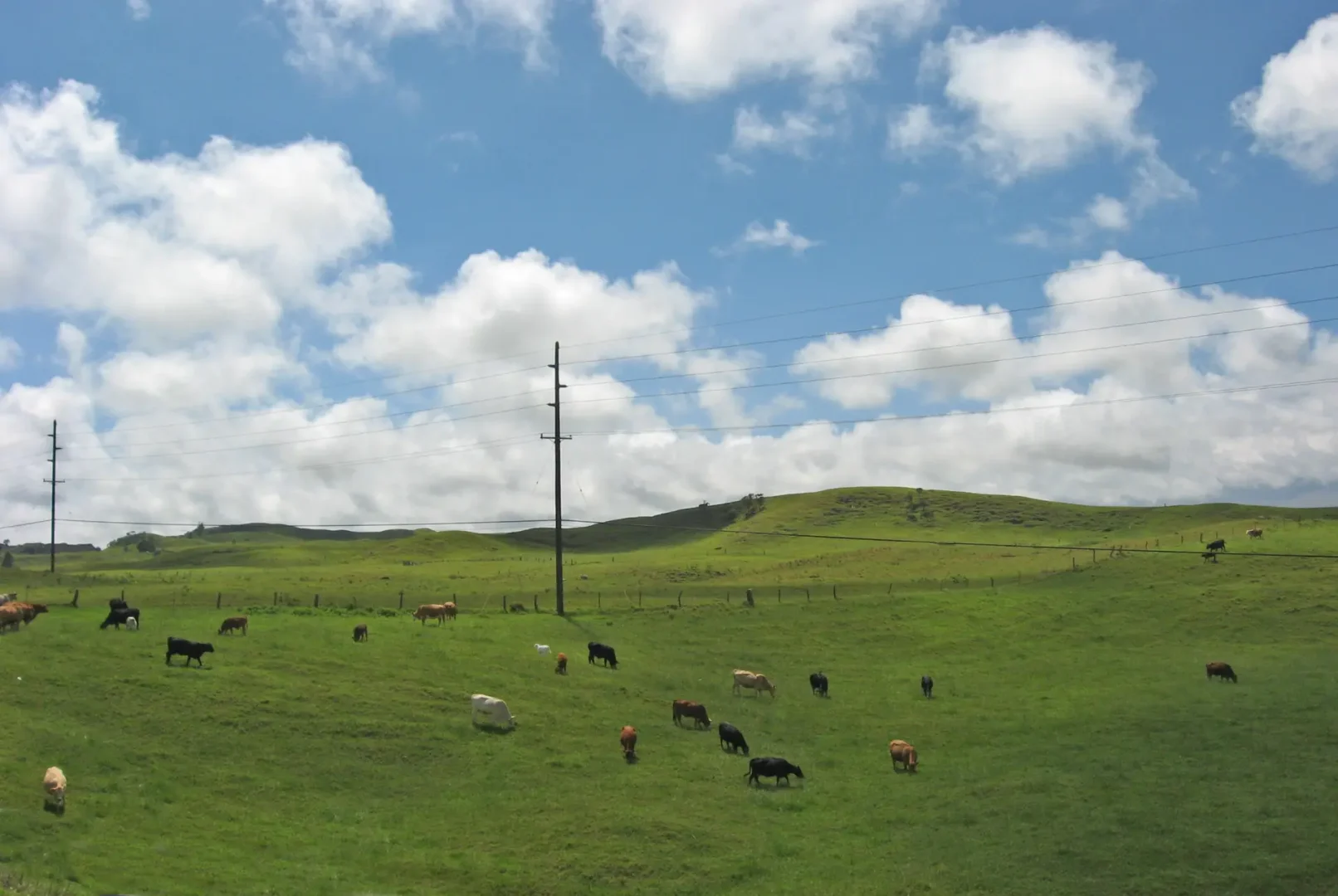
Hawaii land ranges across volcanic islands with lava fields, windward rainforest, dry leeward coasts and agricultural uplands. It sells fastest in and around Honolulu, Kahului, Hilo, Kailua-Kona, and Lihue. Counties owners ask about most: Hawaii County (the Big Island), Maui County, Kauai County, and Honolulu County (Oahu). Remote parcels, far from a paved road, power or water, get a different review than lots on the edge of town.
Regional markets across Hawaii
- Big Island subdivisions: Puna, Hawaiian Acres and Hawaiian Ocean View Estates, large older subdivisions where lots often rely on rainwater catchment.
- Agricultural land: Farm and ranch parcels in the agricultural district across the islands, where the land use district limits residential use.
- Maui and Kauai: Smaller land markets where county rules and water availability decide what can be built.
Hawaii land we review
Big Island subdivision lots in Puna, Hawaiian Acres and Hawaiian Ocean View Estates, agricultural-district lots and small farms, rural-district lots, and leasehold parcels.
What affects the value of Hawaii land
Large older Big Island subdivisions are generally the least expensive fee-simple land in the state, while land on Oahu and Maui is priced far higher.
Frequently asked questions
How do I get a cash offer for my Hawaii land?
Fill out the form on this page with the parcel's address or APN and acreage. We review it and reply with an offer, or a clear reason we cannot make one.
Do I have to accept the offer?
No. The review is free and carries no obligation. You decide whether to accept what we send.
Do I pay a commission to sell my Hawaii land to you?
No agent commission when you sell directly to us. Normal closing costs still apply.
Who records the deed when I sell land in Hawaii?
The Bureau of Conveyances. A title or escrow company normally handles it at closing.
What land do you review in Hawaii?
Mostly Big Island subdivision lots in Puna, Hawaiian Acres and Hawaiian Ocean View Estates, agricultural-district lots and small farms, and rural-district lots, with a focus on Hawaii County (the Big Island) and Maui County and the surrounding area. Unusual parcels are welcome; the form has room for details.
Are land sale prices public in Hawaii?
Hawaii records deeds with the state Bureau of Conveyances, and sale information is available through public records, but how to search it varies. Ask the county real property tax office or the Bureau of Conveyances.
Who pays the conveyance tax when I sell land in Hawaii?
Under HRS 247-4 the seller (grantor) pays it, unless a government agency is the seller. The rate starts at 10 cents per $100 of consideration for properties under $600,000 and rises with the value.